
If you’ve ever walked outside, coffee in hand, ready to enjoy that peaceful bubbling sound… and instead found your solar fountain sitting there like a dead pancake in a bowl of water — you’re not alone.
This is one of the most common frustrations with bird bath bubblers.
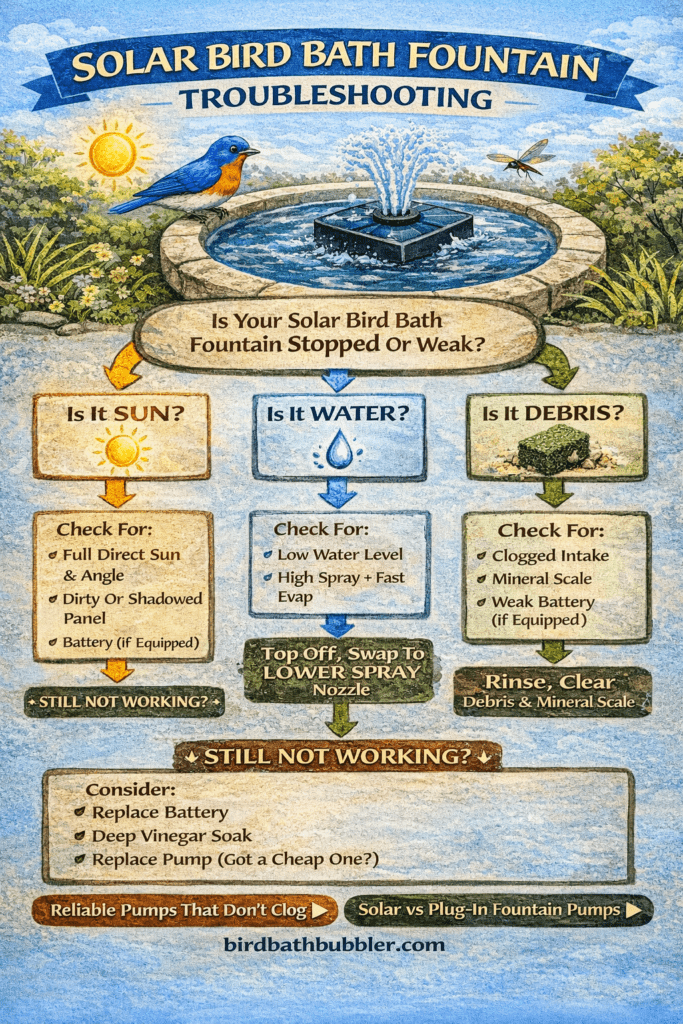
The good news? Most solar fountain failures aren’t permanent. They’re predictable. And once you understand the patterns, you can prevent 90% of them. Let’s break down the real reasons solar bird bath fountains stop working — and how to fix (or avoid) each one.
If you’re still choosing a system, read this first:
👉 Solar vs Plug-In Fountain Pumps
The #1 Reason: Not Enough Sunlight
Solar fountains are brutally honest. No sun = no pump.
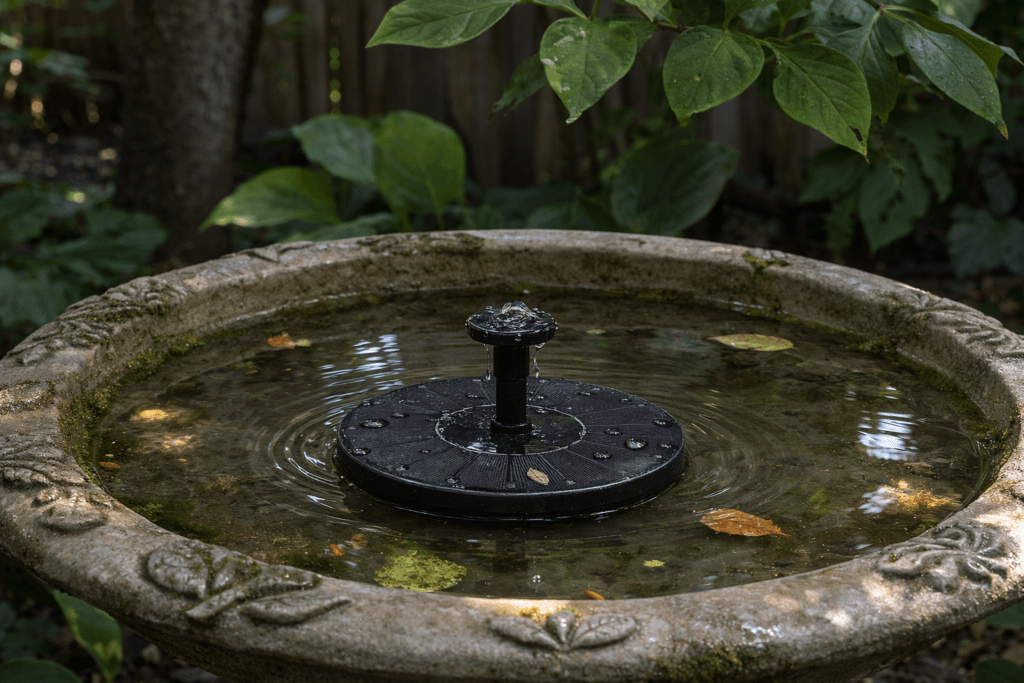
Floating solar fountains (panel built into the unit) are the most sensitive. Even partial shade, passing clouds, or morning/late afternoon angles can cause them to slow down or stop entirely.
What to Check:
- Is the panel in direct sun for at least 4–6 hours?
- Is the panel clean?
- Has seasonal sun angle changed?
Fix (Time: 2–5 minutes)
- Move the bird bath into stronger sunlight
- Or upgrade to an external panel solar pump
External panel systems are more forgiving because you can position the panel independently.
If you want stronger, more consistent performance:
👉 Best Solar Bird Bath Bubblers
The #2 Reason: Debris Clogging the Intake
Pollen, dust, tiny leaf bits, and algae film. Solar fountains — especially floating ones — sit right at the surface where debris collects. When the intake gets blocked, the pump can’t pull water. It may sputter, pulse, or shut off.
What to Check:
- Remove the pump and inspect intake slots
- Look for slimy buildup
- Spin the impeller (if accessible)
Fix (Time: 3–10 minutes)
- Rinse under faucet
- Use a soft brush for intake
- Soak in diluted vinegar if mineral buildup is present
If clogging keeps happening, you may need better filtration:
👉 Reliable Pumps That Don’t Clog
The #3 Reason: Low Water Level
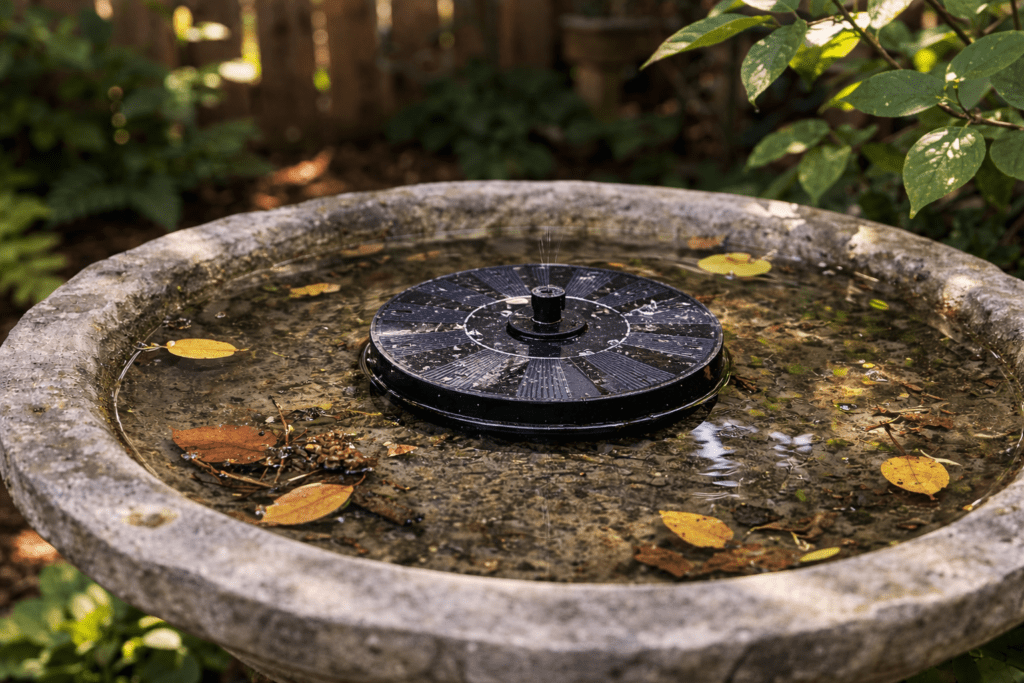
Solar fountains hate shallow water.
If the water drops below the intake:
- Pump sucks air
- Motor overheats
- Flow stops
- Long-term damage can occur
High spray patterns make this worse by increasing evaporation.
What to Check:
- Is the intake fully submerged?
- Is spray too high?
Fix (Time: 1–2 minutes)
- Top off water
- Switch to a lower spray nozzle
This is why gentle bubbling systems are more reliable:
👉 Best Low-Maintenance Fountain Systems
The #4 Reason: Battery Failure (If Equipped)
Some solar pumps include rechargeable batteries.
These batteries:
- degrade over time
- struggle in cold weather
- fail after 1–3 years
If your fountain works in full sun but not in shade anymore, the battery may be fading.
What to Check:
- Does it run only in direct sunlight?
- Has performance declined gradually?
Fix (Time: 10–20 minutes)
- Replace battery (if model allows)
- Or bypass battery if possible
- Or upgrade pump
The #5 Reason: Mineral Buildup (Hard Water)
If you live in a hard water area, mineral scale can form around the impeller.
Symptoms:
- weak flow
- grinding noise
- intermittent start/stop
Fix (Time: 15 minutes)
- Disassemble pump
- Soak in vinegar 30–60 minutes
- Rinse thoroughly
Hard water areas often benefit from higher-quality pumps.
The #6 Reason: Cheap Motor Burnout
Let’s be honest — some $25 floating solar fountains just don’t last. Low-quality motors:
- overheat
- seize
- lose power permanently
If you’ve cleaned everything and it still won’t start in full sun, it may simply be done. This is where upgrading pays off long-term.
When Solar Just Isn’t the Right Fit
Solar is great for:
- clean aesthetics
- easy setup
- yards with strong sun
- casual backyard birding
Solar struggles with:
- heavy tree cover
- shaded patios
- overcast climates
- high debris environments
If you’re constantly troubleshooting, it may be time to compare alternatives:
👉 Solar vs Plug-In Fountain Pumps
Printable Solar Fountain Troubleshooting Checklist

1: Sunlight
☐ Panel in full direct sun
☐ Panel cleaned
☐ Seasonal shade checked
2: Water Level
☐ Intake fully submerged
☐ Spray height reduced
3: Debris
☐ Intake rinsed
☐ Impeller spins freely
☐ Sponge/filter cleaned
4: Battery (If Applicable)
☐ Battery tested
☐ Replaced if weak
5: Mineral Scale
☐ Vinegar soak completed
☐ Impeller cleared
If all boxes are checked and it still doesn’t run in direct sun, the motor may be done.
Time to Complete (Typical Fixes)
- Move to sunnier spot: 2–5 minutes
- Clean intake: 3–10 minutes
- Vinegar soak: 30–60 minutes (mostly passive time)
- Replace battery: 10–20 minutes
Most solar fountain problems can be diagnosed and fixed in under 15 minutes.
Frequently Asked Questions
Why does my solar fountain work in the morning but stop later?
Sun angle shifts throughout the day. Partial shade or panel overheating can reduce performance.
Do solar fountains stop working on cloudy days?
Yes — especially floating solar models without battery backup.
How long should a solar fountain last?
Budget floating models: 1–2 years.
Higher-quality solar pump systems: 2–4+ years.
Can algae stop a solar fountain?
Yes. Algae film can block intake and slow impeller movement.
Is plug-in more reliable?
Generally yes. Plug-in pumps provide consistent power and often have stronger motors.
Resources for More Information
- Cornell Lab of Ornithology (Bird Bath Care): https://www.allaboutbirds.org
- National Audubon Society (Backyard Habitat Tips): https://www.audubon.org
- EPA Mosquito Control Information: https://www.epa.gov/mosquitocontrol
Conclusion: Most Solar Problems Are Predictable
Solar fountains don’t “randomly fail.”
They stop working because of:
- sun limitations
- debris clogging
- low water
- battery degradation
- mineral buildup
- or cheap motor fatigue
If you understand those patterns, solar becomes far less frustrating. But if you’re in a shaded yard or tired of constant troubleshooting, it may be worth considering a more consistent system.
Either way, once you dial in sunlight, filtration, and water level habits, your fountain should run smoothly — and your backyard will go back to being relaxing instead of mysterious.