
If you’re trying to upgrade your bird bath with a fountain pump, this is the fork in the road:
Do you go solar… or plug it in?
I’ve seen people choose based on convenience alone — and then regret it six months later. The truth is, both solar and plug-in fountain pumps can work beautifully. But they work best in different situations.
If you want something easy, affordable, and low maintenance, you need to match the pump to your yard — not just your budget. Let’s break this down clearly so you can choose once and choose right.
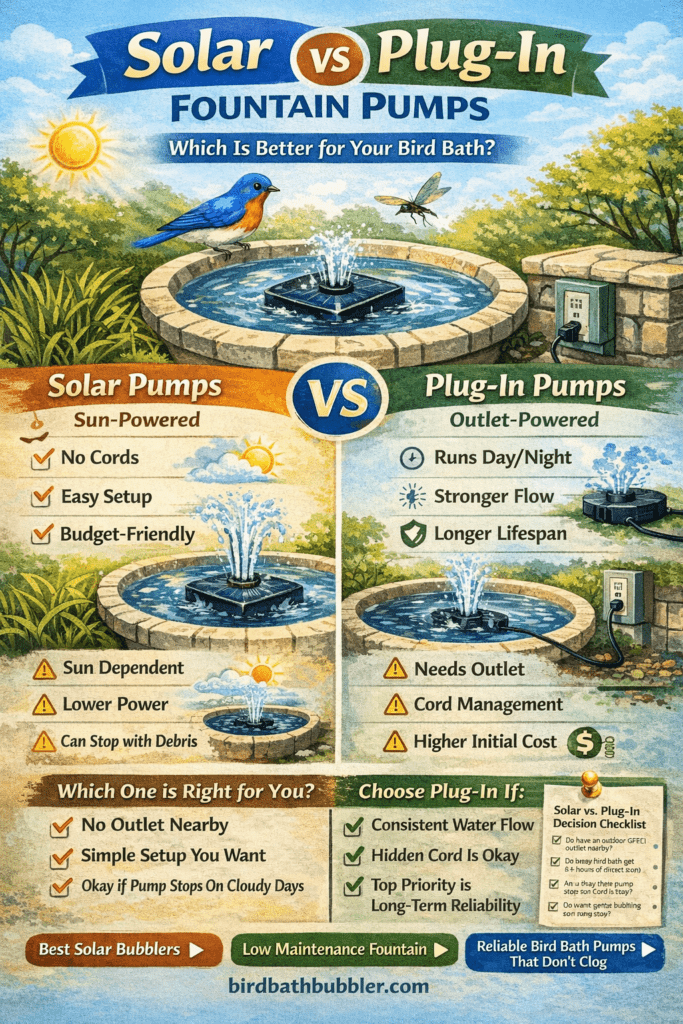
The Quick Difference (Before We Go Deep)
Solar fountain pumps
- Run off sunlight
- No extension cords
- Lower power output
- Can stop in cloudy weather
Plug-in fountain pumps
- Run continuously from an outlet
- Stronger and more consistent
- Require cord management
- Typically last longer
If you’re brand new to bubblers, start here first:
👉 Best Solar Bird Bath Bubblers
👉 Most Reliable Pumps That Don’t Clog
Now let’s go deeper.
Solar Fountain Pumps
There are two main types:
- Floating solar fountains (panel built in)
- Solar pumps with external panel
Setup Time
5–10 minutes
Drop it in, place the panel in sunlight, adjust spray head.
That’s it.
Why People Love Solar
✔ No Cords
This is the #1 reason people choose solar. Clean look. No outdoor outlet required.
✔ Easy DIY Install
If you can place a bowl of water, you can install a solar pump.
✔ Budget-Friendly
Most floating solar fountains cost between $30–$60.
Where Solar Struggles
Here’s where expectations matter.
⚠ Sun Dependent
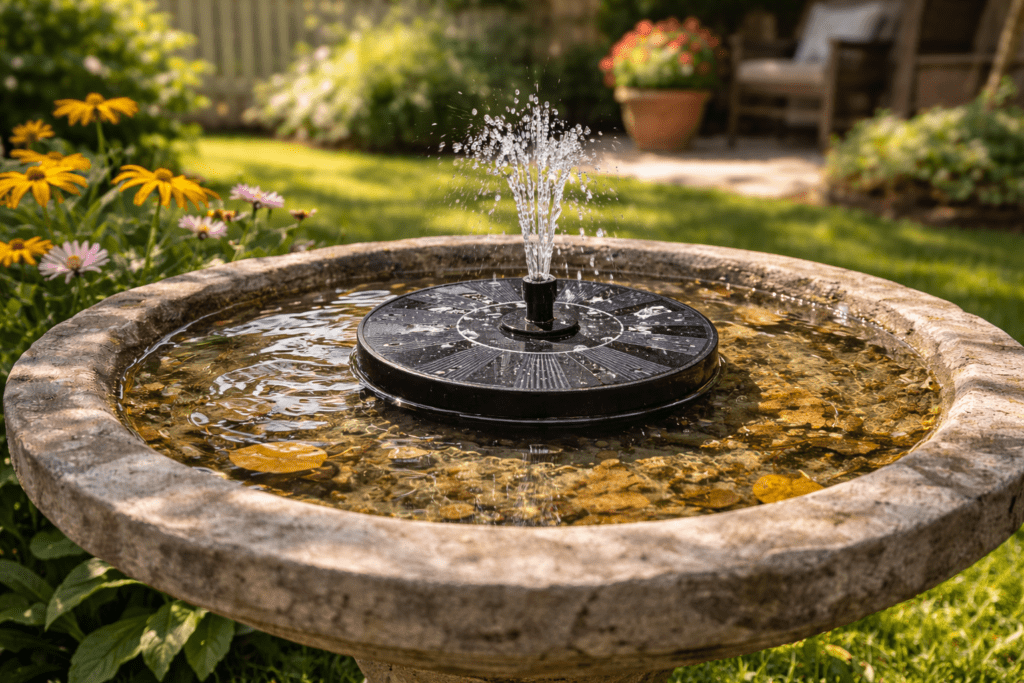
Floating solar fountains only run in direct sunlight. A cloud passes — it stops.
External panel models are better, especially if they include battery backup.
⚠ Lower Power
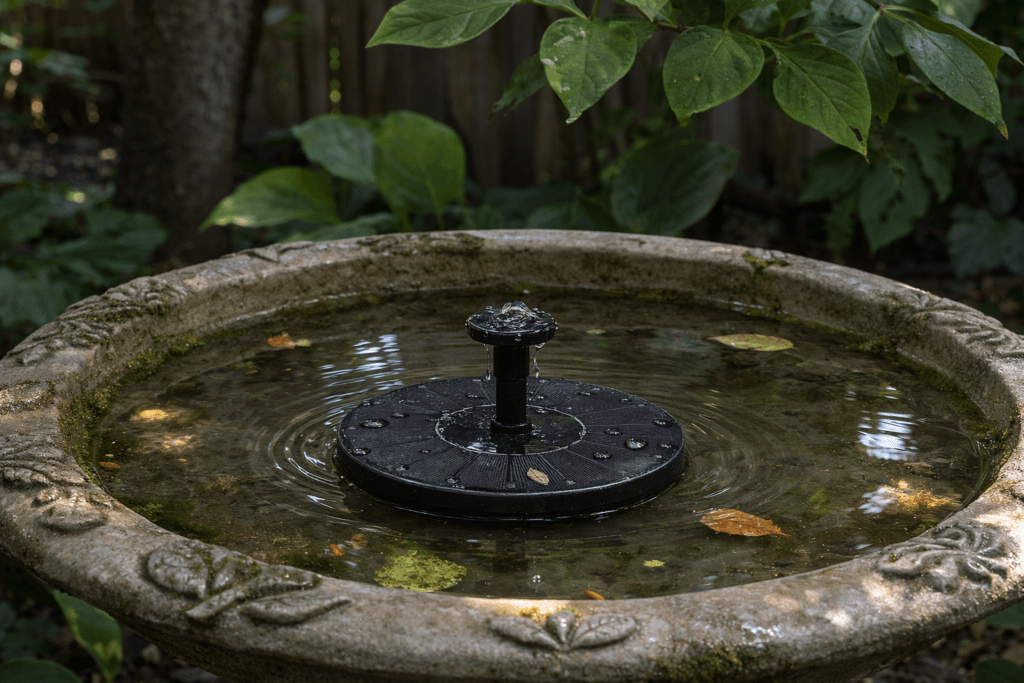
Solar pumps usually create gentle bubbling rather than strong spray. That’s actually ideal for birds — but not dramatic if you want a high fountain effect.
⚠ More Prone to Clogging
Because many are compact and budget-built, debris can stop them faster.
If you live in a leafy yard, you’ll want models with better filtration. See:
👉 Low Maintenance Fountain Systems
Plug-In Fountain Pumps
These run off standard household electricity.
Setup Time
15–30 minutes
You’ll need:
- Outdoor GFCI outlet
- Extension cord if needed
- Cord concealment strategy
Why Plug-In Pumps Win on Performance
✔ Consistent Operation
Runs day and night if you want it to.
✔ Stronger Flow
More water movement. Better aeration. More customizable spray height.
✔ Longer Lifespan
Quality plug-in pumps can last 3–6 years.
Where Plug-In Pumps Can Be a Headache
⚠ Cord Management
If your bird bath sits in the middle of the yard, this can get messy.
⚠ Slightly Higher Energy Cost
Usually minimal — most small pumps use less power than a light bulb.
⚠ Higher Initial Cost
Good units range from $40–$150.
Maintenance Comparison
| Category | Solar | Plug-In |
|---|---|---|
| Filter Cleaning | Weekly | Weekly |
| Reliability | Weather Dependent | Consistent |
| Clogging Risk | Moderate | Lower (Higher Quality Units) |
| Winter Use | Limited | More Flexible |
| Lifespan | 1–4 Years | 3–6 Years |
Both require cleaning. Moving water reduces algae — but it does not eliminate maintenance.
Expect:
- 5–10 minutes per week
- 1 deep clean per month
Which One Should YOU Choose?
Let’s make this practical.
Choose Solar If:
- You don’t have an outlet nearby
- You want the simplest installation
- You’re okay with sun-dependent operation
- You prefer gentle bubbling
Choose Plug-In If:
- You want consistent water flow
- Your yard has shade
- You want long-term durability
- You don’t mind hiding a cord
If reliability is your top concern, read:
👉 Why Solar Fountains Stop Working
Cost Over 5 Years (Realistic View)
Let’s say you replace:
- Floating solar fountain every 2 years
- Plug-in pump every 4–5 years
Long term, the plug-in pump often costs less. But that only matters if you have an outlet and don’t mind cord management.

Printable Decision Checklist
You can copy and print this:
- ☐ Do I have an outdoor GFCI outlet nearby?
- ☐ Does my bird bath get 6+ hours of direct sun?
- ☐ Am I okay if the fountain stops on cloudy days?
- ☐ Do I want strong spray or gentle bubbling?
- ☐ Is low maintenance my top priority?
- ☐ Do I want to avoid cords completely?
Your answers will point you clearly in one direction.
Frequently Asked Questions
Are solar fountain pumps powerful enough?
For bird baths, yes — especially for gentle bubbling. For dramatic spray or pond aeration, plug-in pumps are stronger.
Do plug-in pumps use a lot of electricity?
No. Most small fountain pumps use between 5–20 watts. That’s similar to a small LED light bulb.
Which lasts longer?
Plug-in pumps generally last longer because they have more durable motors and consistent power supply.
Do solar fountains attract more birds?
Birds respond to movement, not power source. Gentle bubbling from either system works well.
Can I use a plug-in pump in winter?
Yes, depending on climate. In freezing conditions, both systems may need removal or winterizing.
More Resources
For water feature and bird safety guidance:
- Cornell Lab of Ornithology – Bird Bath Best Practices
https://www.allaboutbirds.org - National Audubon Society – Backyard Bird Habitat Tips
https://www.audubon.org - EPA Mosquito Control Information
https://www.epa.gov/mosquitocontrol
Final Thoughts
There is no universally “better” pump, rather, there is only better for your yard.
- Solar wins for simplicity and clean aesthetics.
- Plug-in wins for consistency and longevity.
If this is your first bird bath upgrade, I usually suggest starting with a quality solar pump with an external panel. In addition, it keeps things simple while offering more reliability than floating-only models.
However, if you want set-it-and-forget-it durability, plug-in pumps are hard to beat. Your backyard setup, sunlight exposure, and tolerance for cords should decide — not price alone.